Countertop kiosks
Countertop Ordering Kiosks
Compact self-service ordering terminals for counters and reception desks. Nine designs with 15.6, 21.5 and 24 inch screen references.
- 15.6 to 24 inch
- Indoor
- Countertop
- Touchscreen
Self-service kiosks
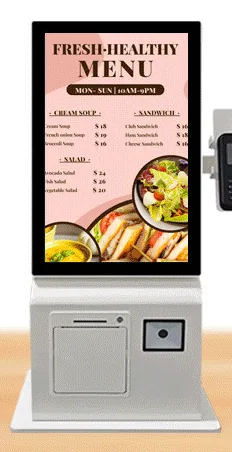
A countertop kiosk makes sense when customers already come to a counter and you want to take orders or payments there without adding another till. It uses space you already have, needs no floor fixing, and keeps help within reach when a customer gets stuck. The questions to settle are how much counter you can give up, whether customers will stand or sit, and where the power, network and card terminal will go.
Countertop Ordering Kiosks are pictured in a range of designs with 15.6, 21.5 and 24 inch screens: upright portrait units, lower landscape units with a tilted screen, and a dual-screen terminal with one screen facing the customer and one facing the operator. Stated for the range are 10-point PCAP touch, 80 mm thermal printer configurations, QR code scanning with an optional NFC reader, and payment-terminal brackets. These are options for the range rather than a fixed specification for every design, so your quotation lists exactly what your chosen design includes. View the countertop range.
The hardware is half of the job. The ordering screens, menu data, receipt layout and the link to your till or kitchen are software, and we scope that with you: see restaurant ordering software for food service, or bespoke kiosk software for anything else. Hardware and software are quoted separately.
Catalogue
One product family in this category
Countertop kiosks
Compact self-service ordering terminals for counters and reception desks. Nine designs with 15.6, 21.5 and 24 inch screen references.
Where they fit
Customers place an order at the counter while staff concentrate on preparing it, and pay at the kiosk where a card terminal and payment integration have been agreed. Orders can pass to a kitchen screen or printer as part of a wider restaurant workflow, subject to the agreed software.
Example application: a service-desk kiosk where customers order items that are not on the shelf, or check in to collect an online order. The application and any link to your retail system are scoped as a software project.
Example application: a counter kiosk at a cinema, attraction or leisure venue, using the thermal printer option for a receipt or collection slip and the scanner option for booking QR codes.
Example application: visitors or guests confirm a booking at a hotel, clinic or office front desk while staff deal with other enquiries. The check-in journey is designed with you and quoted separately from the hardware.
One design in the range is a dual-screen terminal, with a screen facing the customer and a second facing the operator. It suits counters where staff key the order and the customer follows and confirms it on their own screen.
Choosing
Upright portrait designs give a tall menu page with room for photographs, and suit customers who stand. Lower landscape designs carry a tilted screen on a short column, sit below eye level and keep the view across the counter open. The orientation is part of the enclosure design, so choose it with your screen layout in mind.
Designs differ in where the peripherals go. Some carry the payment-terminal bracket on the side of the screen; others have a cradle on the front, between the scanner and the printer. A side bracket adds to the width the kiosk needs on the counter, while a front cradle keeps everything within the body. Tell us which card terminal you use so the position and fit can be checked.
Most designs are single-screen kiosks that the customer uses alone. The dual-screen terminal is closer to a till: staff operate one side and the customer sees the order on the other. Decide who does the keying first, because the software for each is different.
If the counter is short, or a queue for the kiosk would block the queue for the till, look at wall-mounted kiosks or freestanding kiosks instead. The same applies if you want a larger screen: the countertop designs pictured stop at 24 inch.
Beyond the hardware
Applications and management tools are designed and built per project, then quoted separately from the hardware.
Hardware, software and services combined around a job you need done.
Questions
It depends on the design, the screen size and where the card terminal sits. We do not publish a single footprint because the designs differ; the dimensions of the design you choose are confirmed with your quotation. When you measure, allow for the payment-terminal bracket if it is on the side, for access to change the printer paper, for the cable route to a socket and network point, and for a customer to stand in front without blocking the till. If space is tight, send us a photograph and the measurements and we will suggest suitable designs.
The countertop designs pictured have 15.6, 21.5 or 24 inch screens, and each design is offered in its own size or sizes. The wider ordering and payment range is stated from 15.6 to 43 inch, but that statement also covers wall-mounted and freestanding designs. It does not mean every size is offered as a countertop unit. Your quotation confirms the sizes available for the design you pick.
It can be configured for it, in two parts. The hardware part is a payment-terminal bracket or cradle, offered for the range on the side or the front depending on the design. The card terminal itself comes from your payment provider, and a bracket does not prove that a given terminal fits, so we check the model before you order. The software part is the link between the kiosk application and the terminal, which depends on what your provider supports and is scoped as an integration. An NFC reader is a separate option for reading NFC cards and tags; it does not accept bank-card payments on its own. See payment kiosks.
No. An 80 mm thermal printer, a QR code scanner and an optional NFC reader are stated as options for the range, and several of the designs pictured show a printer slot and a scanner window. They are not a fixed specification for every design. Tell us what the kiosk needs to do, such as print a receipt, scan a voucher or read an NFC card, and the quotation will list the peripherals fitted to your configuration. Cash or coin handling, card dispensing, a camera or a microphone are custom-build options that we assess case by case.
Plan for a mains socket and a network connection at the counter, with a tidy cable route so that nothing trails across the worktop. Whether the kiosk connects by cable or wirelessly, and the platform it runs, are confirmed with your quotation and chosen to suit the software you plan to use. If the kiosk will send orders to a kitchen or till, we also agree how those systems connect as part of the software scope.
Describe what the screen needs to do and where it will go. We will recommend the right hardware and software and confirm the configuration in a written quotation.