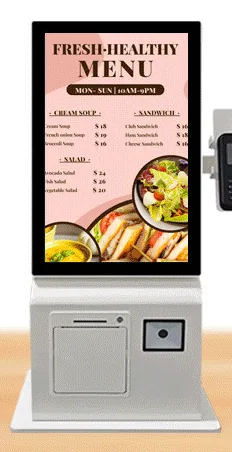
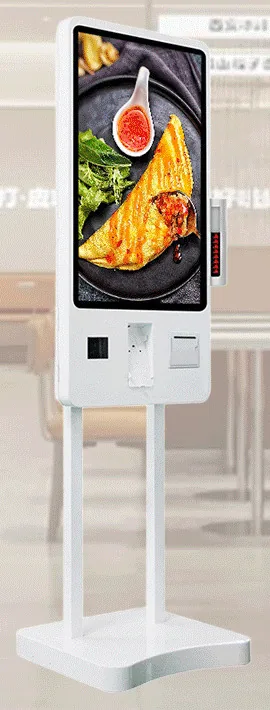
Restaurant POS / Cashier Station
The staffed order and payment point in a restaurant ordering system, scoped together with your kiosks, kitchen screens and collection displays.
Restaurant workflow
Family reference Ref KC-R02
Scoped per project
No standard hardware photo. The equipment for this part of the system is specified with your project.
Orders placed at a kiosk, a till, a tablet or a table QR code all have to reach the kitchen clearly. A kitchen display shows them on a touchscreen at the pass. We scope the screen, the printer and the software together, because one does not work without the others.
Quote-led, not a checkout: we confirm the configuration, price and lead time in your quotation.
Overview
In the restaurant workflow we illustrate, a customer orders at a kiosk, on a tablet or by scanning a QR code at the table, and the order appears on a touchscreen in the kitchen. The team works from that screen, and the pickup number reaches the collection screen automatically for the customer to see. The kitchen display is the middle of that chain.
A kitchen display is not a screen you can buy on its own and plug in. What appears on it, how orders are grouped, what happens when a dish is marked ready and when a ticket prints are all decided by the ordering software. For that reason we always scope the display hardware and the software together, as part of a restaurant ordering project, and never quote the screen as a stand-alone item.
Two kitchen arrangements are illustrated: a kitchen touchscreen working with a kitchen ticket printer, and a kitchen printer on its own for simpler sites. Where a printer is used, the moment a ticket prints is a setting rather than a fixed rule — for example when the order is placed, or when it is marked ready. We agree that with you in the software scope, because kitchens differ.
No hardware specification or environmental rating is supplied for the kitchen screen, and kitchens are hard on electronics: heat, steam, grease and cleaning chemicals. We therefore confirm the screen size, mounting and suitability for the intended position with your quotation, rather than assuming that a general-purpose display will cope. Hardware, software development and ongoing management are described and quoted separately.
Suitable applications
Orders from several kiosks and a till arrive in one queue on a screen at the pass, for example with a ticket printed for the bag when the order is marked ready.
Sending drinks to one screen and hot food to another is an example of order routing that can be scoped in the software. Each extra screen is part of the same assessment.
A single screen can replace a rail of handwritten or printed tickets. You can keep a printer alongside it, for example as a fallback or for a ticket that travels with the order.
Where most orders are collected, the link between the kitchen screen and the collection screen matters most. For example, marking an order ready in the kitchen can be what tells the customer to come forward.
Key features
In the illustrated workflow, orders appear automatically on a touchscreen in the kitchen. The layout of that screen is designed in the software scope.
Two arrangements are illustrated: a kitchen touchscreen working with a ticket printer, and a ticket printer on its own. A screen without any printer is assessed on request.
When a ticket prints is a software setting agreed in the scope — for example when an order is placed, or when it is marked ready. No fixed sequence is assumed.
In the illustrated workflow, the pickup number appears on the collection screen automatically. Both screens are driven by the same ordering software, which is why they are scoped together.
Kiosk, till, tablet and table QR code ordering all appear in the illustrated workflow. Which routes you use, and how each reaches the kitchen, is set out in the software scope.
An alert when a new order arrives is part of the illustrated workflow and can be included in the software scope, for example as a sound or an on-screen highlight.
Screen size, mounting and enclosure are selected for where the screen will sit, and its suitability for heat, steam and grease at that position is confirmed with your quotation.
Configuration options
Choose what you know and leave the rest. Catalogue options are pictured or stated for this range; anything else is recorded as a requirement for us to assess.
How many units this configuration is for (1 to 9,999).
Anything that helps us assess this item, for example where it will go or what it must connect to. Please do not include personal or payment details.
0 of 1,000 characters
No options chosen yet. You can add the item as it is and we will cover the details with you.
Quantity: 1 · 5 of 5 option groups left blank - we cover them in your quotation.
Adding an item builds your enquiry list. It is not an order or a checkout. We confirm the configuration, price and lead time in your quotation.
Kitchen Display System
Qty 1 · no options chosen yet
Technical specifications
How to read the markers
Where an attribute is not listed, it is not specified for the range. That never means the feature is absent.
Touch technology is confirmed with your quotation
Hardware and software are scoped together and confirmed with your quotation
Configuration-dependent
Stated, optional and confirmed
Compatible software and services
Installation considerations
Choose a position at the pass where the whole team can see the screen and reach it to mark orders, away from direct heat, steam and splashes where possible.
Tell us about the conditions at that position. Suitability of the display for heat, steam and grease is confirmed with your quotation rather than assumed.
Provide power and a network connection at the screen. A wired connection is worth considering in kitchens where wireless coverage is unreliable.
Place the ticket printer where tickets can be torn off without crossing a cooking line, and plan where spare paper rolls are kept.
Agree the screen layout, order statuses and print timing before installation day. They are part of the software scope and are tested with your team.
Plan what the kitchen does if the network or a screen fails, for example a fallback printer. Resilience is scoped with the software.
Related products
The staffed order and payment point in a restaurant ordering system, scoped together with your kiosks, kitchen screens and collection displays.
Digital menu boards
Collection screens that show customers which orders are being prepared and which are ready, linked to your kiosks, tills and kitchen.
Mounts and peripherals
Printers, scanners, NFC readers, card-terminal brackets and custom modules for ordering kiosks — compatible options chosen per design, not universal fittings.
Countertop kiosks
Compact self-service ordering terminals for counters and reception desks. Nine designs with 15.6, 21.5 and 24 inch screen references.
Freestanding kiosks
Freestanding self-service ordering kiosks in fourteen enclosure styles, from slim pole stands to full-height towers, with 15.6 to 32 inch screen references.
Digital menu boards
Single or multi-screen digital menu boards for counters and collection points, built from our display families and paired with content management scoped to you.
Frequently asked questions
Not usefully. A kitchen display only works as part of an ordering system: the software decides what appears on the screen, how orders are grouped and what happens when one is marked ready. We therefore scope the display hardware and the software together. If you already run ordering or POS software with a kitchen screen module, tell us what it is and we will assess suitable hardware for it.
It is your choice. Two arrangements are illustrated: a kitchen touchscreen working with a ticket printer, and a printer on its own for simpler sites. Some kitchens keep a printer beside the screen, for example for a ticket that travels with the order or as a fallback. A screen with no printer at all is assessed on request.
Whenever suits your kitchen. Print timing is a software setting agreed in the scope — for example when the order is placed, so that preparation can start from the ticket, or when the order is marked ready, so that the ticket goes out with the food. We do not assume a fixed sequence.
That has to be confirmed for the position you have in mind. No environmental rating is supplied for the kitchen screen as a general item, so we ask about heat, steam, grease and cleaning at the pass, select hardware accordingly, and confirm its suitability with your quotation.
It depends on what your software can send to a kitchen screen and how. We assess that first. Where integration is feasible, it is described and quoted separately from the hardware; where it is not, we will say so and set out the alternatives.
Through the ordering software. In the workflow we illustrate, the pickup number reaches the collection screen automatically — for example when the kitchen marks the order as finished. Exactly what triggers it is agreed in the software scope, which is why we plan the two screens together.
Add it to your enquiry with the options you know, or ask for advice. We recommend the right configuration and confirm it in a written quotation.