Guide
Indoor displays, window displays and outdoor displays
Where a screen will live decides its brightness, enclosure, cooling and mounting. This guide compares indoor, window-facing and outdoor displays and explains why high brightness is not the same as weatherproofing.
6 minute readPublished
Three environments, three different problems
A screen that looks bright in a showroom can be unreadable in a shop window at midday, and a screen that copes with a window can still fail outdoors in the rain. Where the display will live decides almost everything else: brightness, enclosure, cooling, mounting and the work needed to install it.
Brightness is measured in nits (also written cd/m²). The figures in this guide are catalogue-stated for each range, and the value for your configuration is confirmed with your quotation.
Indoor, window-facing and outdoor at a glance
| Consideration | Indoor | Window-facing | Outdoor |
|---|---|---|---|
| Catalogue-stated brightness | 350 to 450 nits freestanding; 300 to 450 nits wall-mounted | 1,000 to 2,500 nits | 1,500, 2,000 or 2,500-nit configurations with a brightness sensor |
| Sizes described | 21.5 to 96 inch freestanding; 10.1 to 98 inch wall-mounted | 32 to 98 inch, single or double-sided | 21.5 to 98 inch |
| Mounting described | Floor stand, wheeled stand or wall | Ceiling-hung or floor stand | Wall, floor-standing or ceiling |
| Main threat to the picture | Reflections from lighting | Direct daylight and heat build-up behind glass | Daylight, rain, dust, heat and cold |
| Protection | Indoor casing with tempered glass | Indoor casing; the building keeps the weather out | IP65 and −30 °C to 45 °C stated for the outdoor range, confirmed for the selected model |
| Typical use | Promotions, menus, reception and wayfinding content | Offers and opening hours aimed at passers-by | Forecourts, drive-through lanes, car parks and public spaces |
Scroll sideways to see the whole table.
Range-level figures. A size range does not mean every size is offered in every design.
Indoor displays: controlled light, widest choice
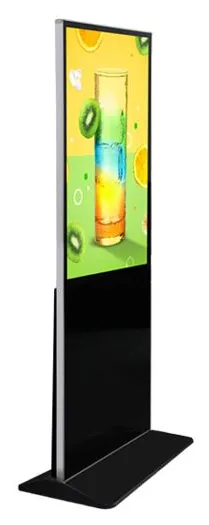
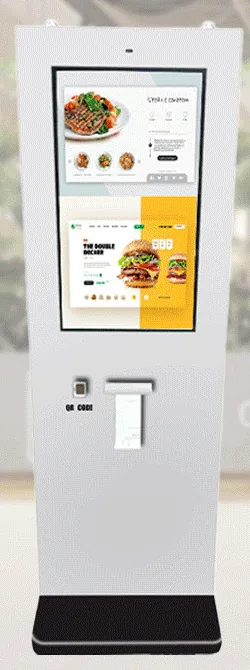
Indoors the lighting is predictable, so standard commercial brightness is enough and the choice of formats is widest. Freestanding displays are described from 21.5 to 96 inch on a floor stand or a wheeled stand, which suits entrances and promotions that move. Wall-mounted displays run from 10.1 to 98 inch, in Full HD with 4K optional. Touch is an option on the freestanding range.
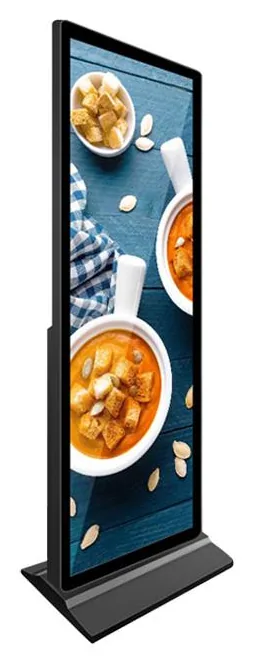
Specialist indoor formats include menu boards, stretched bar displays for shelf edges, full-screen posters and lift screens. The practical checks are sight lines, reflections from downlights or glazing opposite, and a tidy route for power and data.
Window-facing displays: indoors, but fighting daylight
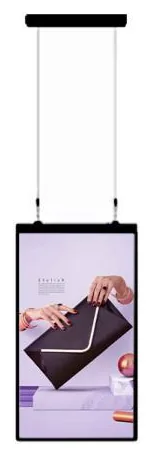
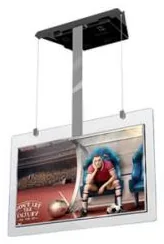
A window display sits inside the building but is viewed from the street, so it competes with daylight and with reflections on the glass. That is why the shop window range is described at 1,000 to 2,500 nits, well above the 300 to 450 nits of a standard indoor screen. Sizes run from 32 to 98 inch, hung from the ceiling or on a floor stand.
Choose the brightness from the window's orientation and shading: a shaded, north-facing window is a different problem from an unshaded south-facing one. A double-sided design can face the street and the shop floor at once. Whether each side can show different content is confirmed for the selected model. Check ceiling fixing points and load, ventilation around the screen, because sun through glass builds heat, and how the unit is reached for cleaning.
Outdoor displays: brightness plus protection
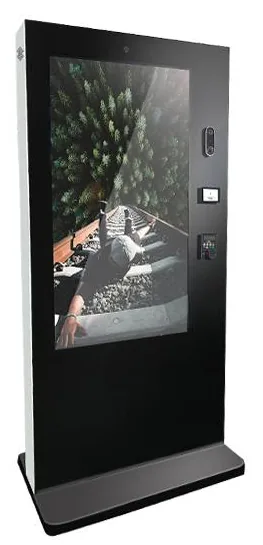
Outdoors, brightness is only half the specification. The outdoor display range is described in 1,500, 2,000 and 2,500-nit configurations with a brightness sensor, in galvanised steel with an outdoor powder-coated finish, cooled by fan or air-conditioning with optional heating. IP65 protection and operation from −30 °C to 45 °C are stated for the outdoor range and confirmed for the selected model with your quotation.
Touch and anti-glare glass are described as options. A printer, scanner, NFC reader or payment terminal can be built in, which is how an outdoor display becomes an outdoor kiosk. EV charging and solar power are bespoke project options only. Plan the groundworks, a protected power supply, a data connection and access for servicing before choosing the model.
What this includes — and what it does not
High brightness is not weatherproofing
A window display is an indoor product. It is bright enough for daylight but has no protection against rain, dust or frost, so it must stay inside the glass.
The high-brightness open-frame module is a component: a 2,000 to 2,500-nit panel with fan cooling, designed to be built into a separate waterproof enclosure. It is not weatherproof by itself, and the outdoor ratings above never apply to it or to any indoor product.
Resolution wording: check the pixels
Full HD means 1920 × 1080 pixels and 4K UHD means 3840 × 2160. Some wide or tall formats, such as the full-screen poster range at 3840 × 1350 or 3840 × 1440, are described as 4K but are not standard UHD, so artwork must be made to the actual pixel size. Where a range is offered as Full HD or 4K-class options, the exact resolution is confirmed for your configuration. Ask for it in writing before content is produced.
Deciding in five steps
Stand where the viewer stands
Visit at the brightest time of day. Note the viewing distance, the direction of the sun and any reflections.
Decide which side of the glass
Inside the building means an indoor or window-facing display. Outside means an outdoor model with its ratings confirmed.
Choose brightness for the worst case
Specify for full daylight, then use a brightness sensor or a schedule so the screen dims in the evening.
Check fixing, power and data
Confirm the wall, ceiling or ground can carry the unit, and that power and a network connection reach the position.
Plan content for the setting
High-contrast designs with large type read better in daylight. Decide who updates content and how, for example through a digital signage CMS.
Questions to take to a supplier conversation
- What brightness is confirmed for this exact size and configuration, and is there a brightness sensor?
- For outdoor models, which ingress protection rating and operating temperature range are confirmed for the selected model?
- How is the unit cooled and, where needed, heated, and what maintenance does that involve?
- What is the exact resolution in pixels, and which orientations are supported?
- What does the wall, ceiling or ground need to carry, and who supplies the fixings?
- Is the glass anti-glare or otherwise treated, and how should it be cleaned?
- Which media player or operating system is included, and how is content updated?
- For window positions, how much ventilation space does the screen need behind the glass?
- Can the display follow a schedule so it is not at full brightness overnight?
- What warranty and support terms are set out in the quotation?
Next steps
Most signage projects mix environments: a window screen to draw people in, indoor screens to inform them, and sometimes an outdoor totem by the road. Our digital advertising solution shows how the hardware, the content management and your own processes fit together, and the rollout checklist covers planning. To discuss a site, request a quote and include photographs of each position.